
Focus Keyword: What is Accounting
Secondary Keywords: Accounting Basics, Accounting Definition, Types of Accounting, Importance of Accounting, Accounting Principles
Meta Title (SEO):
What is Accounting? Definition, Types, Importance & Complete Guide (2026)
Meta Description (SEO):
Learn what accounting is, why it is important, its objectives, principles, types, accounting cycle, financial statements, and career opportunities. A complete beginner-friendly guide.
URL Slug:what-is-accounting
What is Accounting?
Accounting is one of the most important parts of every business, whether it is a small shop, an online business, a large corporation, or even a non-profit organization. It helps record, organize, analyse, and report financial transactions so that business owners, investors, managers, and government authorities can make informed decisions.
Without proper accounting, a business cannot accurately determine whether it is making a profit or a loss. Every payment received, every expense incurred, every asset purchased, and every liability created should be properly recorded. This systematic recording of financial information is what accounting is all about.
In today’s digital world, accounting is no longer limited to paper ledgers. Modern accounting software has made it much easier to manage financial records, prepare reports, track expenses, and generate invoices automatically. Whether you are a freelancer, entrepreneur, accountant, student, or business owner, understanding accounting is an essential skill.
This guide explains everything you need to know about accounting, including its definition, objectives, importance, principles, types, accounting cycle, and much more.
Table of Contents
- What is Accounting?
- Definition of Accounting
- Objectives of Accounting
- Why Accounting is Important
- History of Accounting
- Basic Accounting Terminology
- Types of Accounting
- Accounting Principles
- Accounting Cycle
- Accounting Equation
- Financial Statements
- Advantages of Accounting
- Limitations of Accounting
- Real-Life Examples
- Frequently Asked Questions
- Conclusion
Definition of Accounting
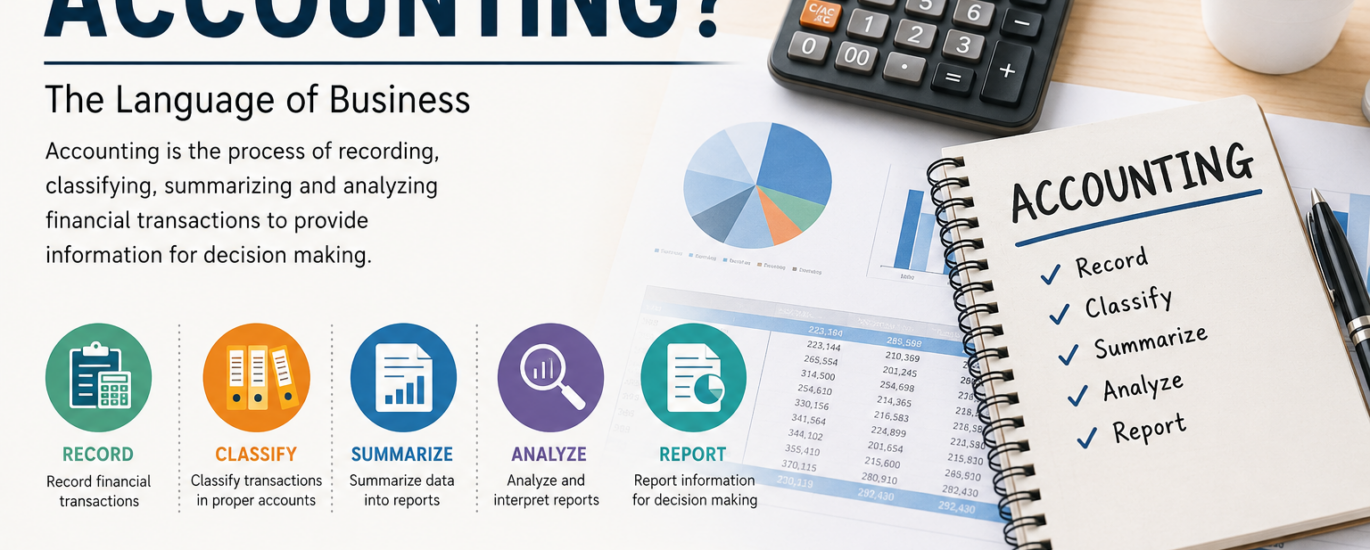
Accounting is the process of recording, classifying, summarising, analysing, and communicating financial information about a business or organisation.
The primary purpose of accounting is to provide accurate financial information that helps stakeholders make informed business decisions.
According to the American Accounting Association (AAA):
“Accounting is the process of identifying, measuring, and communicating economic information to permit informed judgments and decisions.”
In simple words, accounting tells us:
- How much money a business earns
- How much money it spends
- Whether it makes a profit or a loss
- What assets the business owns
- What liabilities it owes
- The overall financial health of the business
What Does an Accountant Do?
An accountant performs many important financial tasks, including:
- Recording daily financial transactions
- Preparing invoices and bills
- Managing payroll
- Calculating taxes
- Preparing financial statements
- Monitoring cash flow
- Budget planning
- Financial reporting
- Business analysis
- Ensuring legal compliance
Modern accountants also use cloud accounting software to automate many of these processes.
Objectives of Accounting
Accounting serves several important objectives that help businesses grow and remain financially stable.
1. Recording Financial Transactions
The first objective of accounting is to maintain accurate records of every financial transaction.
Examples include:
- Sales
- Purchases
- Salary payments
- Utility bills
- Bank deposits
- Loan payments
Proper records reduce errors and improve financial transparency.
2. Measuring Business Performance
Accounting helps determine whether a business is profitable or operating at a loss.
Business owners can easily compare:
- Monthly revenue
- Expenses
- Net profit
- Gross profit
- Operating costs
This information helps improve future planning.
3. Assisting Decision Making
Business decisions should always be based on accurate financial information.
Accounting reports help answer questions such as:
- Should the business expand?
- Can new employees be hired?
- Is it the right time to invest?
- Should prices be increased?
Reliable accounting information supports better business decisions.
4. Managing Cash Flow
Cash flow is the lifeblood of every business.
Accounting helps monitor:
- Cash received
- Cash paid
- Outstanding invoices
- Upcoming payments
- Available working capital
Healthy cash flow ensures smooth business operations.
5. Legal Compliance
Governments require businesses to maintain proper financial records for taxation and regulatory purposes.
Accounting helps businesses:
- Calculate taxes accurately
- File tax returns
- Maintain audit records
- Comply with financial regulations
6. Protecting Business Assets
Accounting keeps track of company assets, including:
- Cash
- Equipment
- Furniture
- Inventory
- Vehicles
- Buildings
This prevents misuse and supports effective asset management.
Why is Accounting Important?
Accounting plays a critical role in every successful organisation.
Better Financial Planning
Businesses can prepare realistic budgets based on historical financial data.
Budget planning helps control unnecessary expenses.
Profit Measurement
Accounting clearly shows:
- Gross Profit
- Operating Profit
- Net Profit
Without accounting, it is impossible to know whether a business is actually earning money.
Business Growth
Financial reports help identify:
- Best-selling products
- High expenses
- Customer payment trends
- Seasonal sales
These insights support business growth.
Investor Confidence
Investors prefer businesses with transparent and accurate financial records.
Proper accounting builds trust among:
- Investors
- Banks
- Business partners
- Government agencies
Better Loan Approval
Banks often require financial statements before approving loans.
Accounting provides:
- Balance Sheet
- Income Statement
- Cash Flow Statement
These documents demonstrate the financial health of the business.
Brief History of Accounting
Accounting has existed for thousands of years.
Ancient civilizations, including Mesopotamia and Egypt, maintained records of trade and taxation.
The modern accounting system began in 1494 when the Italian mathematician Luca Pacioli introduced the Double-Entry Bookkeeping System. This revolutionary method became the foundation of modern accounting and is still used worldwide today.
With the advancement of technology, accounting has evolved from handwritten ledgers to cloud-based accounting software, making financial management faster, more accurate, and more secure.
Basic Accounting Terminology
Before learning advanced accounting concepts, it’s important to understand some common terms.
Assets
Assets are resources owned by a business that have economic value.
Examples include:
- Cash
- Bank balance
- Inventory
- Computers
- Office equipment
- Vehicles
- Buildings
Liabilities
Liabilities are obligations or debts that a business owes to others.
Examples include:
- Bank loans
- Supplier payments
- Salaries payable
- Utility bills
- Taxes payable
Capital
Capital refers to the money invested by the owner into the business.
It represents the owner’s financial interest in the company.
Revenue
Revenue is the income generated from selling products or providing services.
Revenue is often called sales or turnover.
Expenses
Expenses are the costs incurred while running the business.
Examples include:
- Rent
- Electricity
- Salaries
- Marketing
- Internet bills
- Transportation
Profit
Profit is the amount remaining after deducting all expenses from total revenue.
Formula:
Profit = Revenue − Expenses
Loss
A loss occurs when business expenses exceed total revenue.
Consistent losses indicate financial problems that require immediate attention.
Equity
Equity represents the owner’s claim on business assets after deducting liabilities.
Formula:
Equity = Assets − Liabilities
Types of Accounting
Accounting is a broad field with several specialised branches. Each type serves a different purpose depending on the needs of a business, organisation, or individual. Understanding these types helps businesses choose the right accounting methods and systems.
1. Financial Accounting
Financial accounting focuses on preparing financial statements for external users such as investors, banks, shareholders, and government agencies.
The primary financial statements include:
- Income Statement
- Balance Sheet
- Cash Flow Statement
- Statement of Changes in Equity
Financial accounting follows internationally accepted accounting standards to ensure consistency and transparency.
Example:
A company prepares annual financial statements to apply for a bank loan.
2. Management Accounting
Management accounting provides financial information to internal management for planning and decision-making.
It helps managers:
- Prepare budgets
- Analyse business performance
- Control operational costs
- Forecast future profits
- Improve business efficiency
Unlike financial accounting, management accounting reports are prepared only for internal use.
3. Cost Accounting
Cost accounting analyses the cost of producing products or delivering services.
It helps businesses determine:
- Production costs
- Material costs
- Labour costs
- Manufacturing overhead
- Cost per unit
Manufacturing companies heavily rely on cost accounting to maximise profitability.
4. Tax Accounting
Tax accounting focuses on calculating taxes according to government regulations.
It includes:
- Income tax calculation
- VAT/GST reporting
- Corporate tax
- Payroll tax
- Tax return preparation
Proper tax accounting helps businesses avoid penalties and remain compliant with tax laws.
5. Auditing
Auditing involves examining accounting records to verify their accuracy and compliance.
There are two main types:
- Internal Audit
- External Audit
Audits help detect fraud, improve internal controls, and increase stakeholder confidence.
6. Government Accounting
Government accounting manages public funds and ensures transparency in the use of taxpayer money.
Government organisations prepare budgets, monitor public expenditure, and report financial performance according to public sector regulations.
7. Forensic Accounting
Forensic accounting combines accounting, auditing, and investigative techniques to uncover financial fraud and support legal proceedings.
It is commonly used in:
- Fraud investigations
- Financial disputes
- Insurance claims
- Court cases
Basic Accounting Principles
Accounting follows a set of generally accepted principles that ensure financial information is reliable, consistent, and comparable.
Business Entity Principle
A business is treated as a separate entity from its owner.
For example, if the owner uses business money for personal expenses, that transaction must be recorded separately.
Going Concern Principle
This principle assumes that a business will continue operating in the foreseeable future.
Unless there is evidence that the business will close, accountants prepare financial statements on this assumption.
Cost Principle
Assets should be recorded at their original purchase cost rather than their current market value.
Example:
A computer purchased for £900 should continue to be recorded at its purchase price (subject to depreciation), even if its market value changes.
Matching Principle
Expenses should be recorded in the same accounting period as the revenue they helped generate.
This provides a more accurate picture of business performance.
Revenue Recognition Principle
Revenue should be recognised when it is earned, not necessarily when cash is received.
For example, if a business delivers services in June but receives payment in July, the revenue belongs to June.
Consistency Principle
Businesses should consistently use the same accounting methods from one period to another.
Consistency allows meaningful comparisons between financial reports.
Full Disclosure Principle
Financial statements should include all material information that may influence users’ decisions.
This improves transparency and trust.
Fundamental Accounting Concepts
Several concepts underpin modern accounting systems.
Accrual Concept
Income and expenses are recognised when they occur, regardless of when cash changes hands.
Prudence Concept
Potential losses should be recognised as soon as they are anticipated, while profits should only be recognised when they are certain.
Materiality Concept
Only information that could significantly affect decision-making needs detailed reporting.
Minor items may be grouped together.
Monetary Measurement Concept
Only transactions that can be measured in monetary terms are recorded in accounting records.
Employee satisfaction or brand reputation, while valuable, cannot usually be recorded directly in financial statements.
Double-Entry Bookkeeping System
Almost every modern business uses the double-entry accounting system.
This system ensures that every financial transaction affects at least two accounts.
Basic Rule:
Every Debit has an equal Credit.
This keeps the accounting equation balanced and reduces the likelihood of errors.
Example
Suppose a business purchases office furniture for £1,500 using cash.
Debit: Furniture £1,500
Credit: Cash £1,500
One asset (Furniture) increases while another asset (Cash) decreases.
Understanding Debit and Credit
Many beginners find debit and credit confusing, but the concept becomes straightforward with practice.
Debit (Dr)
Debit generally increases:
- Assets
- Expenses
Debit generally decreases:
- Liabilities
- Equity
- Revenue
Credit (Cr)
Credit generally increases:
- Liabilities
- Equity
- Revenue
Credit generally decreases:
- Assets
- Expenses
Simple Example
A business receives £3,000 from a customer.
Debit: Cash £3,000
Credit: Sales Revenue £3,000
Cash increases, and revenue increases.
The Accounting Cycle
The accounting cycle is a systematic process used to record and report financial transactions.
Step 1: Identify Transactions
Every financial activity must first be identified.
Examples:
- Sales
- Purchases
- Salary payments
- Utility bills
- Loan repayments
Step 2: Record Journal Entries
Each transaction is recorded in the general journal using the double-entry system.
Step 3: Post to the Ledger
Journal entries are transferred to their respective ledger accounts.
The ledger provides the balance of each account.
Step 4: Prepare the Trial Balance
A trial balance lists all ledger balances.
Its purpose is to verify that:
Total Debits = Total Credits
If the totals do not match, errors must be investigated.
Step 5: Prepare Adjusting Entries
At the end of the accounting period, adjustments are made for:
- Depreciation
- Accrued expenses
- Prepaid expenses
- Accrued revenue
These adjustments ensure accurate financial reporting.
Step 6: Prepare Financial Statements
Using the adjusted trial balance, businesses prepare:
- Income Statement
- Balance Sheet
- Cash Flow Statement
These reports provide a clear picture of financial performance and position.
Step 7: Close Temporary Accounts
Revenue and expense accounts are closed at the end of the accounting period.
Their balances are transferred to retained earnings or capital, preparing the books for the next accounting period.
Journal vs Ledger
Many beginners confuse these two important accounting records.
| Journal | Ledger |
|---|---|
| Records transactions in chronological order | Groups transactions by account |
| First step in recording | Second step after journal entries |
| Shows complete transaction details | Shows account balances |
| Also called the Book of Original Entry | Also called the Book of Final Entry |
Trial Balance
A trial balance is prepared after posting all transactions to the ledger.
Its objectives include:
- Checking arithmetic accuracy
- Detecting posting errors
- Preparing financial statements
- Verifying debit and credit totals
Although a balanced trial balance indicates that total debits equal total credits, it does not guarantee that every transaction has been recorded correctly.
Accounting Equation
The accounting equation is the foundation of the double-entry accounting system.
Accounting Equation:
Assets = Liabilities + Owner’s Equity
Example
Suppose you start a business by investing £10,000.
- Assets = £10,000 (Cash)
- Liabilities = £0
- Owner’s Equity = £10,000
Equation:
£10,000 = £0 + £10,000
Now suppose you take a £5,000 bank loan.
- Assets = £15,000
- Liabilities = £5,000
- Equity = £10,000
Equation:
£15,000 = £5,000 + £10,000
Every accounting transaction must keep this equation balanced.
Financial Statements in Accounting
Financial statements are formal reports that summarise a business’s financial activities during a specific accounting period. They help business owners, investors, lenders, and other stakeholders understand the financial health and performance of an organisation.
The three primary financial statements are:
- Income Statement
- Balance Sheet
- Cash Flow Statement
Together, these reports provide a complete picture of a business’s profitability, financial position, and cash movement.
1. Income Statement
An Income Statement, also known as a Profit and Loss Statement, shows the revenue earned and expenses incurred during a specific period.
It answers one of the most important business questions:
“Is the business making a profit or a loss?”
A typical income statement includes:
- Revenue (Sales)
- Cost of Goods Sold (COGS)
- Gross Profit
- Operating Expenses
- Operating Profit
- Taxes
- Net Profit
Example
Suppose a business reports:
- Revenue: £50,000
- Expenses: £38,000
Net Profit = £12,000
This means the business earned a profit of £12,000 during the accounting period.
2. Balance Sheet
A Balance Sheet provides a snapshot of a company’s financial position at a specific point in time.
It includes three major components:
Assets
Resources owned by the business, such as:
- Cash
- Inventory
- Equipment
- Furniture
- Buildings
- Accounts Receivable
Liabilities
Amounts owed by the business, including:
- Bank Loans
- Supplier Payments
- Taxes Payable
- Salaries Payable
Owner’s Equity
The owner’s investment plus retained earnings after deducting liabilities.
The Balance Sheet always follows the accounting equation:
Assets = Liabilities + Owner’s Equity
3. Cash Flow Statement
A profitable business can still face financial difficulties if it runs out of cash. That is why the Cash Flow Statement is essential.
It shows how cash enters and leaves the business.
Cash flows are divided into three categories:
Operating Activities
Cash generated from daily business operations.
Examples:
- Customer payments
- Salary payments
- Rent
- Utility bills
Investing Activities
Cash related to buying or selling long-term assets.
Examples:
- Purchasing machinery
- Buying vehicles
- Selling equipment
Financing Activities
Cash received from or paid to investors and lenders.
Examples:
- Bank loans
- Loan repayments
- Dividend payments
Advantages of Accounting
Accounting provides numerous benefits to businesses of all sizes.
1. Better Decision Making
Accurate financial reports help business owners make informed decisions based on real financial data rather than assumptions.
2. Improved Budget Planning
Historical accounting records make it easier to prepare realistic budgets and control unnecessary expenses.
3. Performance Evaluation
Accounting enables businesses to compare financial performance over different months or years, helping identify strengths and weaknesses.
4. Legal Compliance
Maintaining accurate accounting records helps businesses comply with tax regulations and avoid legal issues.
5. Investor Confidence
Transparent financial statements increase trust among investors, lenders, and business partners.
6. Easier Loan Approval
Banks often require financial statements before approving business loans. Well-maintained accounts improve the chances of loan approval.
7. Fraud Detection
Regular accounting and auditing help identify irregularities, reduce fraud risks, and strengthen internal controls.
8. Better Cash Management
Accounting allows businesses to monitor income and expenses, ensuring there is enough cash to meet daily operational needs.
Limitations of Accounting
Although accounting is an essential business function, it also has certain limitations.
Historical Information
Accounting mainly records past transactions and may not accurately predict future business performance.
Human Errors
Incorrect data entry or calculation mistakes can affect the accuracy of financial reports.
Estimates
Certain accounting figures, such as depreciation or bad debt provisions, rely on estimates rather than exact values.
Cannot Measure Non-Financial Factors
Accounting does not directly measure factors such as:
- Employee satisfaction
- Customer loyalty
- Brand reputation
- Market competition
These factors also influence business success.
Real-Life Examples of Accounting
Example 1: Retail Shop
A grocery store records:
- Daily sales
- Supplier purchases
- Employee salaries
- Electricity bills
- Inventory purchases
At the end of each month, accounting reports reveal whether the shop is making a profit.
Example 2: Freelancer
A freelance web developer tracks:
- Client payments
- Software subscriptions
- Internet bills
- Office expenses
Accounting helps determine taxable income and monitor profitability.
Example 3: Manufacturing Company
A manufacturing company records:
- Raw material costs
- Labour expenses
- Production overhead
- Sales revenue
Cost accounting helps determine the cost of producing each product.
Common Accounting Mistakes
Many beginners make avoidable accounting errors. Being aware of these mistakes can improve the accuracy of financial records.
- Mixing personal and business expenses
- Forgetting to record small transactions
- Failing to reconcile bank accounts
- Ignoring invoices and receipts
- Incorrect debit and credit entries
- Not backing up accounting data
- Delaying bookkeeping until month-end
- Misclassifying expenses
- Forgetting depreciation
- Not reviewing financial reports regularly
Avoiding these mistakes leads to more reliable financial information and better business decisions.
Career Opportunities in Accounting
Accounting offers a wide range of career opportunities across industries.
Popular accounting careers include:
- Accountant
- Chartered Accountant (CA)
- Certified Public Accountant (CPA)
- Auditor
- Tax Consultant
- Financial Analyst
- Cost Accountant
- Management Accountant
- Payroll Specialist
- Finance Manager
- Budget Analyst
- Internal Auditor
- Accounts Officer
- Bookkeeper
- Chief Financial Officer (CFO)
With the increasing adoption of digital accounting software and cloud technologies, skilled accounting professionals remain in high demand worldwide.
Frequently Asked Questions (FAQ)
What is accounting in simple words?
Accounting is the process of recording, organising, and reporting financial transactions so that businesses can understand their financial performance and make informed decisions.
Why is accounting important?
Accounting helps businesses monitor income, control expenses, prepare financial statements, comply with tax regulations, and support better decision-making.
What are the main types of accounting?
The major types include Financial Accounting, Management Accounting, Cost Accounting, Tax Accounting, Government Accounting, Auditing, and Forensic Accounting.
What is the accounting equation?
The accounting equation is:
Assets = Liabilities + Owner’s Equity
It forms the foundation of the double-entry bookkeeping system.
What is double-entry bookkeeping?
Double-entry bookkeeping records every transaction with at least one debit and one credit, ensuring that the accounting equation remains balanced.
What is the difference between bookkeeping and accounting?
Bookkeeping focuses on recording daily financial transactions, while accounting involves analysing, interpreting, and reporting financial information for decision-making.
What software is used for accounting?
Businesses use a variety of accounting software to manage invoices, expenses, payroll, inventory, and financial reports. Cloud-based solutions have become especially popular due to their accessibility and automation features.
Can small businesses benefit from accounting?
Absolutely. Proper accounting helps small businesses manage cash flow, reduce errors, prepare taxes, and make informed financial decisions.
What skills are required for accounting?
Important skills include attention to detail, analytical thinking, numerical accuracy, problem-solving, communication, and proficiency with accounting software.
Is accounting a good career?
Yes. Accounting offers stable career opportunities, competitive salaries, and growth across industries, making it an attractive profession for many individuals.
Conclusion
Accounting is much more than recording numbers—it is the language of business. Every successful organisation, from a small startup to a multinational corporation, relies on accurate accounting to measure performance, manage resources, and plan for the future.
By understanding the fundamentals of accounting, including financial statements, accounting principles, the accounting cycle, and the different branches of accounting, you can make better financial decisions and build a stronger foundation for personal or business success.
Whether you are a student beginning your accounting journey, a freelancer managing your finances, or a business owner seeking better financial control, learning accounting is an investment that delivers long-term value.
Call to Action
Looking for practical accounting tools? Explore Tafhim for free accounting software, invoice generators, expense trackers, financial calculators, and other business tools designed to simplify accounting and financial management.
SEO Recommendations for This Post
- Focus Keyword: What is Accounting
- SEO Title: What is Accounting? Definition, Types, Principles & Complete Guide (2026)
- Meta Description: Learn what accounting is, its objectives, types, principles, accounting cycle, financial statements, advantages, and career opportunities in this complete beginner’s guide.
- Suggested Internal Links:
- What is Bookkeeping?
- Accounting Cycle Explained
- Journal vs Ledger
- Trial Balance Guide
- Balance Sheet Explained
- Cash Flow Statement Guide
- Free Accounting Software
- Invoice Generator
- Expense Tracker
